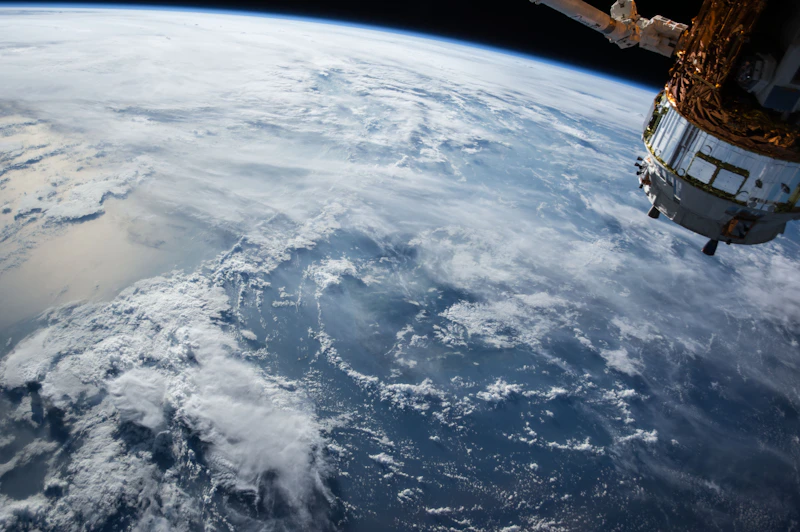
Gravity is the weakest of the four fundamental forces, yet it dominates the large-scale structure of the universe. Every object with mass attracts every other object with mass. You are being pulled toward your computer right now, and your computer is being pulled toward you. The forces are just too small to notice. The Earth, however, has enormous mass, and its gravitational pull is hard to ignore.
Newton’s law of universal gravitation states that the force between two masses is proportional to the product of their masses and inversely proportional to the square of the distance between them. The constant of proportionality, G, is tiny: 6.674 times 10 to the negative 11 newton-meters squared per kilogram squared. This small number is why gravity is weak compared to electromagnetism. A simple refrigerator magnet easily overcomes the entire Earth’s gravity to hold up a paper clip.
On Earth’s surface, gravity accelerates objects at about 9.81 m/s². This value varies slightly with latitude and altitude. At the equator, centrifugal effects reduce it to about 9.78 m/s². At the poles, it is about 9.83 m/s². On the Moon, it is only 1.62 m/s², which is why astronauts bounced so dramatically. Our Gravitational Force Calculator lets you compute the force between any two masses.
Escape velocity is the minimum speed needed to break free from a gravitational body without further propulsion. For Earth, this is about 11.2 km/s. For the Moon, only 2.4 km/s. For Jupiter, a staggering 59.5 km/s. This is why launching rockets is hard. You need enormous fuel tanks just to reach those speeds. Try our Escape Velocity Calculator for other planets.
Orbital velocity is slower than escape velocity but fast enough to keep falling around the planet without hitting it. The ISS orbits at about 7.66 km/s, completing a lap every 90 minutes. Geostationary satellites orbit at about 3.07 km/s at an altitude of 35,786 km, matching Earth’s rotation. Our Orbital Velocity Calculator computes these values for any altitude.
Tidal forces arise because gravity weakens with distance. The side of Earth facing the Moon feels a stronger pull than the far side, creating two tidal bulges. This is why we have two high tides per day, not one. The same principle explains why comets break apart near Jupiter and why galaxies can be tidally disrupted by neighbors.
General relativity refined our understanding. Einstein showed that gravity is not a force but the curvature of spacetime caused by mass and energy. This predicts phenomena that Newton’s law cannot: gravitational lensing, time dilation near massive objects, and gravitational waves. For most practical purposes, though, Newton’s law is sufficient.